


The complete guide
Whole House Water Filter Buyer's Guide
The problem this solves
Most people notice their water before they do anything about it. Maybe the kitchen tap smells faintly of a swimming pool on a hot day. Maybe the shower screen keeps getting a gritty film. Maybe the washing machine filter fills with sand every few months and you have stopped asking why.
Town water is treated before it reaches you, but it still travels through a long network of pipes to get to your house. Chlorine is added on purpose, and you can often taste and smell it. Fine sediment, rust flakes and grit get picked up along the way, especially after works on the street or when a main is flushed.
A point of use filter deals with one tap. That is fine if the only thing bothering you is a glass of water at the sink. If the problem shows up in the shower, the kettle, the laundry and the outside tap as well, a single filter under the sink is the wrong shape of solution.
A whole house water filter takes a different approach. It goes on the pipe where water enters the property, before that pipe branches out. Filter there and you have filtered everything downstream at once.
How a three stage system works
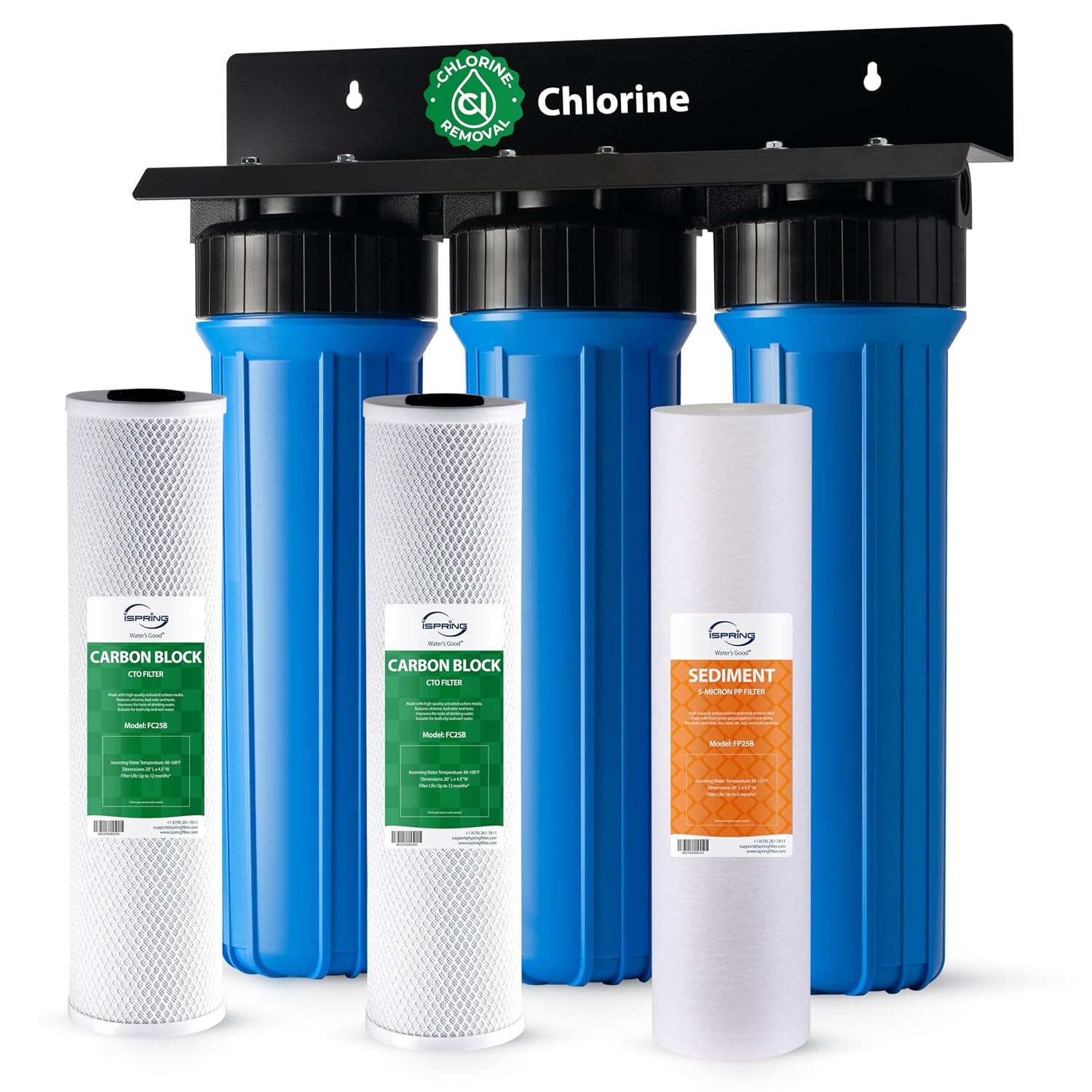
This unit uses three large cartridges in a row. Water goes through them in sequence, and each one has a job.
The first stage is a polypropylene sediment filter rated to 5 microns. Think of it as the strainer. It catches grit, silt, rust particles and anything else physical in the water. It does the dirty work on purpose, because protecting the stages behind it makes the whole system last longer.
The second and third stages are carbon block cartridges made from coconut shell carbon. Carbon block is dense, and water has to squeeze through it rather than flow around loose granules. These stages are designed to reduce chlorine taste and odour. Running two of them in series means the water gets a longer contact time with the carbon than a single cartridge would give. The maker states that the cartridges are tested by an independent third party to meet NSF/ANSI standards.
There is no tank and no pump. The system runs on the pressure already in your mains, which is why it needs no power point and keeps working if the electricity goes out.
Why cartridge size matters more than you think
People often look at a filter system and judge it by the number of stages. Cartridge size matters just as much.
These cartridges are about 51 cm tall and 11.4 cm across, the big blue format. Compare that to a small 25 cm cartridge and the difference in filtering area is large. More area means water passes through more slowly per square centimetre, which gives the carbon time to do its job and keeps the pressure drop lower.
That is why this system is rated to about 57 litres per minute. A house with two showers running and a washing machine filling can pull a surprising amount of water at once. Undersize the filter and you feel it immediately as weak pressure upstairs.
Capacity follows the same logic. Around 379,000 litres is quoted, with a filter life cycle of one year. For a family of four those two figures tend to land close together.
Who this suits
This system makes sense if you own your home, you are on drinkable mains water, and the issues you want to address are chlorine taste and odour or visible sediment. It suits households where the complaint is general rather than located at one tap.
It also suits people who are tired of replacing small filters on multiple appliances and would rather deal with one point.
It is not the right choice in a few situations. If you rent, a permanently plumbed system needs your landlord's permission and a trade to fit it. If your supply is not town water, this is not the product for that job and you should get professional advice first. And if you specifically want total dissolved solids reduced, this is not that type of system.
Choosing and planning the install
Start with the space. The unit measures 61.6 cm wide, 19.7 cm deep and 70.5 cm tall, and it weighs 20.41 kg before any water is in it. You need a solid wall or frame to mount it on, and you need room underneath so the housings can drop clear when you unscrew them. Allow roughly the height of a cartridge below the unit, plus elbow room on each side for the wrench.
Next, the location. It should be where the main line enters the building, which is usually a garage, basement, utility space or sheltered external box. Keep it out of direct sun and well away from anywhere that freezes. The operating range is about 4 °C to 38 °C.
Then, the plumbing. This connects directly into your mains supply, so a licensed plumber must install it. Ask them to fit isolation valves on both sides. Without those, every cartridge change means shutting off water to the whole house. Ask about a pressure gauge too, because watching the pressure drop grow is the clearest early warning that the sediment cartridge is loading up.
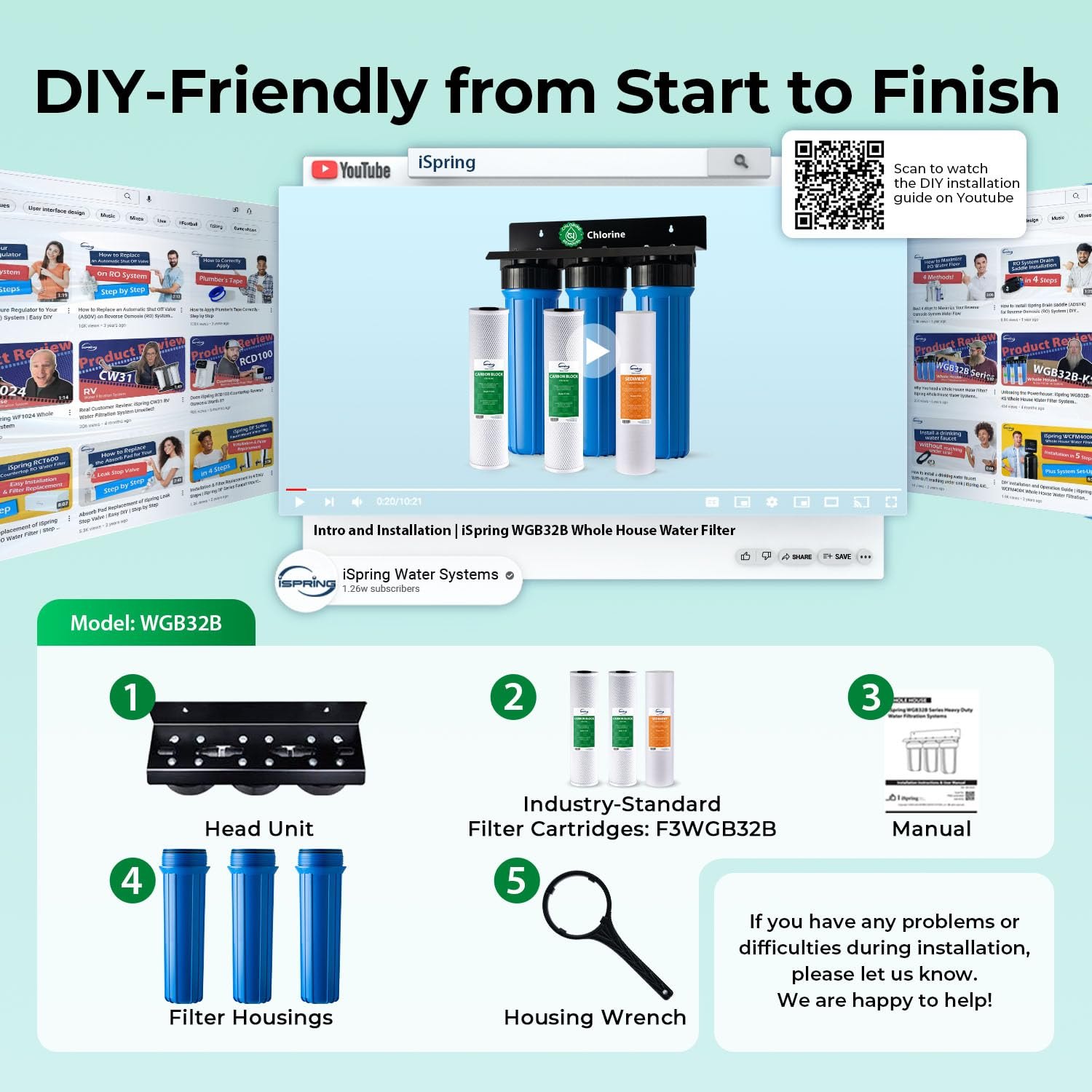
Finally, budget for the fittings. The box includes the system, three filters and a wrench. Pipework, valves and adaptors specific to your home are extra, and your plumber will supply them.
Living with it
Day to day, there is nothing to do. The system has no settings and no controls. It sits there while water goes through it.
Cartridge changes are the only routine task. Shut the valves, release the pressure, use the wrench to unscrew each housing, swap the cartridge, rinse the housing and check the O-ring is clean and seated properly before you screw it back on. Open the valves slowly, then run a cold tap for a few minutes to clear the air and flush out any carbon fines. The water can look cloudy or grey briefly. That settles.
Write the date on the housing with a marker when you change it. It takes five seconds and saves a lot of second guessing a year later.
Change sooner than the schedule if you notice the flow dropping off, the pressure falling at the taps, or the chlorine taste coming back. The sediment cartridge is usually the first to go and it is the cheapest one to replace. Keeping a spare in the cupboard is a sensible habit, particularly if your area has works on the mains from time to time.
The short version
If your water problems show up at more than one tap, filtering at the main line is the sensible place to start. This three stage water filter system uses a 5 micron sediment cartridge followed by two coconut shell carbon block cartridges, all in the large 51 cm format that keeps flow rates high and pressure drop low.
It is tankless, needs no power, and is rated to about 57 litres per minute with a capacity near 379,000 litres and a one year filter life. It is designed to reduce chlorine taste and odour and sediment in drinkable mains water, and nothing more than that.
Measure your space, check you have somewhere frost free with room below the housings, and get a licensed plumber to put it in with isolation valves either side. Do that, and the only thing you will think about afterwards is the once a year cartridge change.